Tsakonian: The only living Doric language in the world – Words that survive to this day
In a small area of the eastern Peloponnese there is a linguistic treasure that has survived for centuries. In the villages of Tsakonia, around Leonidio, Tyros and Agios Andreas, people still speak a language that to most Greeks seems almost incomprehensible. It is the Tsakonian dialect, one of the most distinctive forms of the Greek language and, according to linguistic tradition, the only modern Greek variety directly linked to ancient Laconian, that is, the Doric dialect of ancient Laconia.
This is not a «frozen» form of ancient Greek. Tsakonian is a living language that has evolved over the centuries, acquired its own grammar, phonology and vocabulary, and has been influenced, like all living languages, by contact with other varieties. Its distinctiveness, however, lies precisely in its ancient linguistic origin and in the way that origin has survived to the present day.
From the Doric of Laconia to Tsakonia
The history of Tsakonian is one of the most interesting chapters of Greek dialectology. Unlike most modern Greek dialects, which are historically linked to Hellenistic Koine, Tsakonian goes back to ancient Laconian, the Doric variety spoken in Laconia.
The geographical position of Tsakonia and the relative isolation of its mountain communities are considered important factors that helped preserve its linguistic distinctiveness.
The dialect differs so greatly from Standard Modern Greek, and from other Greek dialects as well, that the Centre for the Greek Language notes that for many non-native speakers it sounds like an almost «exotic» language and is to a large extent hard to understand.
Where Tsakonian is spoken today
Historic Tsakonia lies in the eastern Peloponnese, in the Kynouria area of Arcadia. Traditionally the language is associated with settlements such as Leonidio, Tyros, Agios Andreas, Prastos, Kastanitsa, Sitaina, Melanoi, Pramatefti and Sapounakeika.
Scholars mainly distinguish Northern and Southern Tsakonian, while of particular interest is also the older Tsakonian variety of the Propontis, which was associated with the villages of Vatka and Havoutsi in Asia Minor.
Words that reveal the ancient heritage
One of the most striking features of Tsakonian is the words that are still in use and show historical connections with ancient Greek forms.
Ύο (ýo) – water. This is one of the best-known Tsakonian words and is linked to the ancient «ὕδωρ» (hýdōr).
Μάτη (máti) – mother. The word shows a historical connection with the ancient «μήτηρ» (mḗtēr).
Σάτη (sáti) – daughter/girl. It is linked to the ancient «θυγάτηρ» (thygátēr) and is a characteristic example of the linguistic continuity that has been studied in Tsakonian.
Γρούσσα (groússa) – tongue/language. Another characteristic Tsakonian word, found in the relevant recording of the dialect.
αβουγό (avougó) – egg
εζού (ezoú) – I
μούζα (moúza) – fly
αμέρα (améra) – day
σέρι (séri) – summer (harvest season)
το κρία (to kría) – meat
τšειρ αμέρε (tšir amére) – three days
τσούνερ έσι; (tsoúner ési?) – whose are you? (who are your people?)
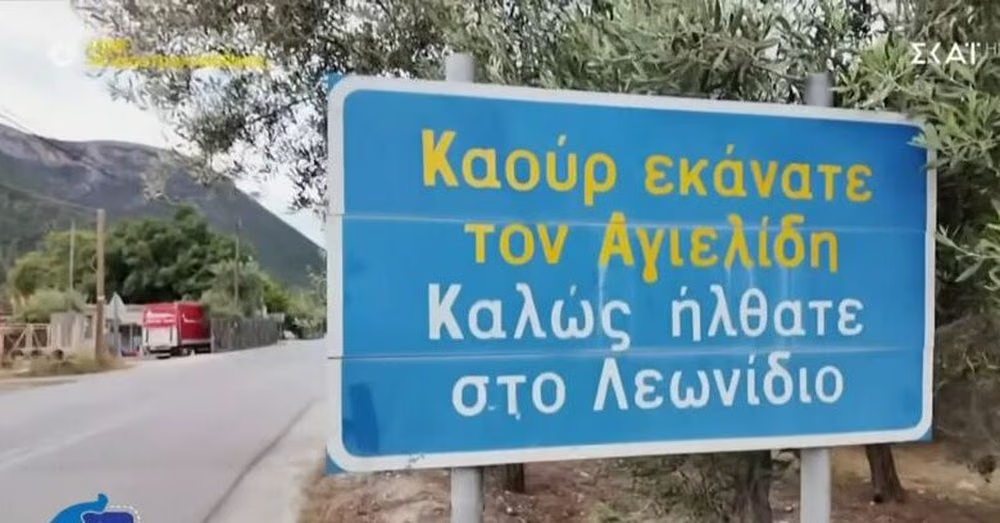
καούρ εκάνατε (kaoúr ekánate) – welcome
These particular words have become especially well known because they show how different the development of a language can be over the centuries. However, the presence of an ancient root in a word does not mean that today's Tsakonian word is identical to the ancient one. On the contrary, it is the result of a long historical linguistic evolution.
For the other words and their exact meanings, reference to specialised lexicographical material is required, since Tsakonian shows local variations and different recorded forms. The most important work remains the three-volume «Dictionary of the Tsakonian Dialect» by Thanasis P. Kostakis, published by the Academy of Athens in 1986 and 1987.
A dictionary that took decades
The effort to record Tsakonian is not recent. As early as the 19th century and the beginning of the 20th century, a number of Greek and foreign scholars studied the language.
Important were the works of Michael Deffner and the French linguist Hubert Pernot. Later, Thanasis P. Kostakis devoted a large part of his life to recording Tsakonian. His «Short Grammar of the Tsakonian Dialect» appeared in 1951, while his great three-volume dictionary was published by the Academy of Athens in 1986-1987.
The dictionary is not simply a list of words. It includes material from field research, phonetic phenomena and dialectal data, and remains to this day a basic source for the study of Tsakonian.
Why it is in danger of being lost
The great paradox of Tsakonian is that while its historical value is enormous, its future is not considered secure.
The spread of Standard Modern Greek through education, the media, population movements and greater communication between communities gradually limited the use of the local dialect.
Thus Tsakonian has passed from a time when it was an everyday means of communication to a period in which its use is limited mainly to certain communities and older age groups.
The crucial question for its linguistic survival is not only how many people know Tsakonian, but whether the language is being passed on from the older to the younger generations.
«If we lose our language…»
For the people of Tsakonia, the dialect is not simply an object of linguistic study. It is directly linked to local identity.
The educator and scholar of Tsakonian Eleni Manou has described this relationship strikingly, saying: «If we lose our language, we cannot say that we are Tsakonians».
The phrase captures the deeper problem a language faces when it stops passing naturally from generation to generation: together with the words, a part of the collective memory and cultural identity of a community is in danger of being lost.
A language that still has a voice
Tsakonian, then, is not a fossil of antiquity. It is a modern, living linguistic variety of exceptionally ancient origin.
That is exactly what makes it unique.
In a world where many small languages and dialects are disappearing, Tsakonian can still be heard in the streets and homes of Tsakonia. Every word used by an elderly person and passed on to a younger one is a small link in a chain that connects today's Peloponnese with ancient Laconia.
And perhaps this is its most striking feature: ancient Doric exists not only in books and inscriptions. Part of it can still be heard as living speech, in a small corner of Greece.