2,000-year-old Greek manuscript proves the historicity of Christ
2,000-year-old Greek manuscript proves the historicity of Christ
New analysis of the ancient text of Josephus with a reference to the appearance of Jesus after the crucifixion
An independent researcher from Spain argues that versions of the famous Testimonium Flavianum —the passage
about Jesus in the Jewish Antiquities of Flavius Josephus (c. 93-94 AD)— may preserve an early, more neutral record of what Jesus’ disciples claimed to have seen after the crucifixion.
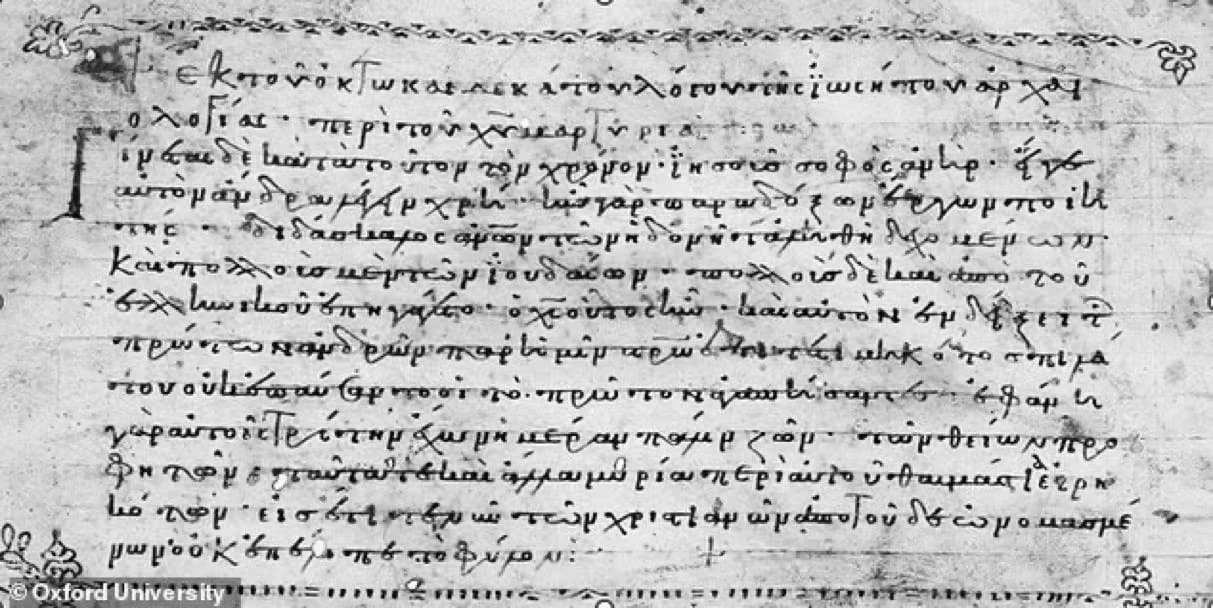
Josephus, a Jewish historian who was not a Christian, wrote an extensive history of the Jewish people.
This passage (Antiquities 18.63-64) is the most extensive extra-biblical reference to Jesus from the 1st century and has been the subject of intense scholarly debate for centuries.
In its surviving Greek form it presents Jesus as a «wise man», a «doer of startling deeds», a «teacher», who «was the Christ», was crucified by Pilate, «appeared to [the disciples] on the third day alive» in accordance with prophecies, and says that the «tribe of the Christians» still existed.
What the researcher claims
Jesús Fernández-Pedrera Correa compared the Greek tradition with the Latin (Jerome, late 4th c.), Arabic (Agapius of Hierapolis, 10th c.) and Syriac (Michael the Syrian, 12th c.) versions.
These secondary traditions uniformly weaken the statement «he was the Christ», turning it into «he was thought» or «he was believed to be» the Messiah.
The Arabic version presents the appearance after death as something the disciples «reported», and not as a fact confirmed by the historian himself.
The researcher argues that this wording matches the way Josephus elsewhere recorded the beliefs and reports of religious groups without necessarily adopting them.
The Greek phrase linking the appearance with the fulfilment of prophecies looks more like Christian preaching. He admits, however, that the reconstruction remains unproven and that the surviving versions do not allow us to determine with certainty exactly what Josephus originally wrote about the Resurrection.
His paper was published in August 2026 as a working paper on Zenodo,
entitled «The Testimonium Flavianum in Four Transmission Lines: Greek, Latin, Arabic, and Syriac».
There he defends a limited form of authenticity and identifies the messianic statement as the clearest possible alteration, while the reference to the appearance remains more uncertain.
The debate is not new. For decades most scholars have accepted that the passage has an authentic core (a reference to a wise man who was crucified by Pilate and left followers), but that certain phrases were added or reinforced by Christian copyists.
Already Origen (3rd c.) noted that Josephus did not accept Jesus as the Messiah.
The Arabic version of Agapius (brought to light by Shlomo Pines in 1971) is considered by many to be closer to a neutral form.
A second, short reference in Josephus, almost universally accepted as authentic, concerns James, «the brother of Jesus who was called Christ» (Antiquities 20.200). This reference strengthens the view that Josephus knew of the existence of Jesus and His disciples.
As the researcher himself acknowledges, however, the exact original wording remains reconstructed and uncertain.
The Testimonium Flavianum continues to be an important extra-biblical piece of evidence for the historicity of Jesus as a person who was crucified and left His disciples as continuers of His work, while the details of its theological wording remain the subject of ongoing philological research.