In Memory of the National Martyr Konstantinos Katsifas - 28/10/2018
The martyrology is a soul-profiting narrative that does not depart from reality, and which has always encouraged and heartened the enslaved Greek people.
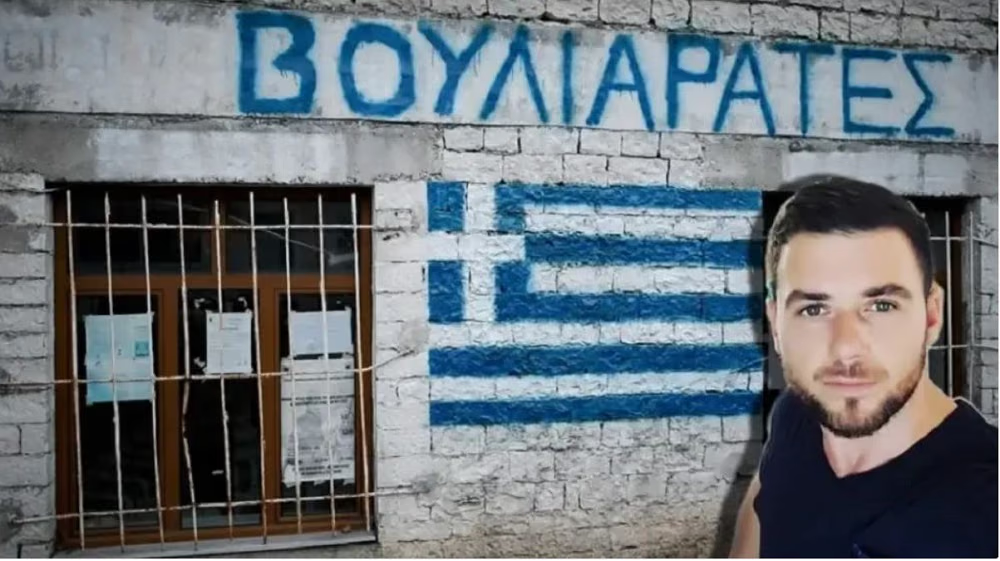
Konstantinos Katsifas was born on 3 September 1983 AD in the village of Bularat (Vouliarates) in Northern Epirus to pious parents, Ioannis and Vasiliki, who raised him on the streams of the Christian faith. Dropull (Deropoli), to which this village belonged, was the spiritual centre of the Greeks of Northern Epirus, who struggled hard and daily to preserve their faith in Christ, their Greek language and their Greek consciousness.
Those years, however, were very hard in Albania, which held these regions of Epirus. Poverty and lack of freedom prevailed. Churches were demolished and Christians were persecuted and tortured. At the age of seven, Konstantinos and his parents moved further south to free Greece, in order to live the rest of their lives in freedom and in the admonition of the Lord.
Konstantinos grew up but never forgot his place of origin, which he visited often, helping and heartening his fellow villagers. He was the brave young man of the village. A builder by trade, he successfully turned his hand to many technical jobs. The older he grew, the more often he visited Vouliarates, while in Greece too he was present at every national call. He was full of honour, hard-working, loving towards his brethren and always willing to lend a helping hand to his neighbour.
The wonderful carved wooden iconostasis of Saint Athanasios in Vouliarates had been repaired by him after the damage it had suffered at the hands of the irreverent. He decked his village with flags and celebrated the national anniversaries with all his soul, but he never neglected to study the Fathers, the Tradition and the Theology of the Church. He prayed fervently night and day. He often walked up to the ruined Monastery of the Dormition of the Theotokos a few kilometres above his village, where he kept vigil, praying to the Most Holy Theotokos, giving a life of worship and divine radiance to a deserted place.
Konstantis had by now reached the age of 35. His presence, however, in the villages of Northern Epirus, and above all his action in defence of the religious and national rights of his fellow villagers, annoyed the ruler of Albania, Edi Rama, who was not known for his love of Christians and Greeks. So, on the morning of 28 October 2018 AD, a day of national anniversary, and on the occasion of the decking with flags of the nearby Greek military cemetery by Konstantis himself, Edi Rama sent a special, fully armed unit of praetorians, which pursued him into the surrounding hills and finally killed him.
It is said that the first Albanian policemen, who were ordered to put him to death before the special unit arrived, hesitated to take the life of this guileless man of God. Konstantinos, with the bravery that distinguished him throughout his life, did not hide; he waited for his persecutors on a rock, and when they drew near, he opened his arms wide, forming with his body the shape of the life-giving Cross, cried out “Long live Greece” and gave up his spirit to the Lord, receiving at that very moment the unfading crown of martyrdom.
The Albanians then took the body of Konstantinos and would not hand it over, as also often happened in the days of Ottoman rule. After struggles and prayers, the precious body of Konstantinos was returned to his family so that the funeral service and his burial could be celebrated in a godly manner on 8 November 2018 AD, on the very feast of the Holy Archangels. A multitude of moved Christians from all over the Greek world was present in Vouliarates that day. Many of them were also persecuted by the Albanian state authorities, spending the night in police cells.
Our people honour the memory of Konstantinos Katsifas of Vouliarates on 28 October. This narrative, in the manner of a synaxarion, may also have a sequel. In any case, however, it is no small thing that the list of our new martyrs and national martyrs is growing. It is a blessing that springs from Orthodoxy and gives birth to optimism. The unshakeable faith of some to struggle and sacrifice themselves for the sake of their ideals makes a most profound impression in an age that thinks it has left behind sacrifice and self-denial as a way of life.
Yet it is not unreasonable either. For if one looks around calmly and without prejudice, one will find that trials, oppression and persecution are not lacking in our own age either.
Stathis Kefalouros