Exports: How Greek yogurt won over the Italians
Greek yogurt is on a «runaway course», with exports rising rapidly - Which markets are the best customers
From a relatively limited export category, Greek yogurt has developed into one of the most dynamic pillars of Greek food products and is by far the most important product among the country’s total dairy exports.
Italy has proved to be a key market for Greek yogurt exports, with Greek yogurt holding a prominent position in the neighbouring market, whether branded or private label.
How much dairy exports to Italy have grown
Evidently, the momentum it has built up has brought dairy products to third place among our exports to Italy. According to the analysis of the Office of Economic and Commercial Affairs of the Greek embassy in Rome, at the top of exports were mineral fuels and mineral oils, which kept first place and recorded a spectacular rise of 82.2%, from 311.5 million euros to 567.5 million euros.
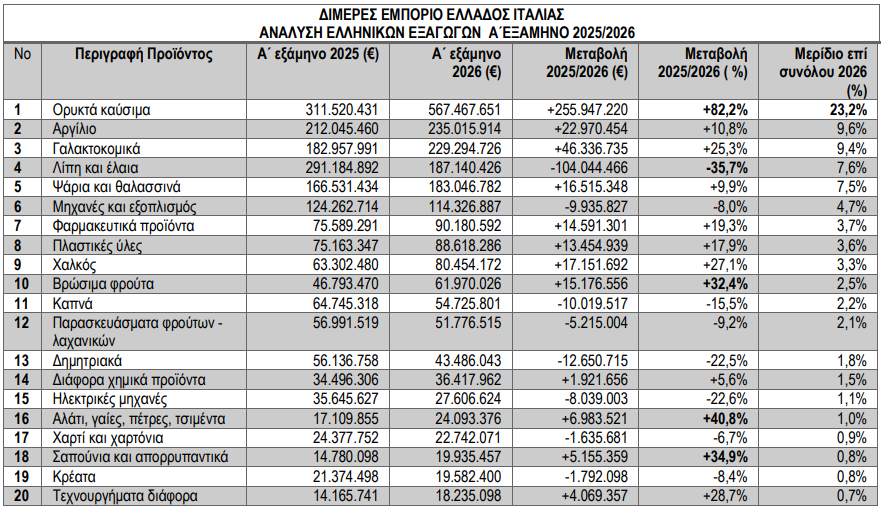
Aluminium climbed to second place among Greek exports, while dairy products took third place, overtaking animal and vegetable oils.
Specifically, dairy exports rose by 25.3%, reaching 229.3 million euros from 183.0 million euros. they took third place.
Data from a recent Altroconsumo survey show that Greek yogurts were among the top choices of Italian consumers, demonstrating the product’s strong penetration of the Italian market.

The top three markets
And as the report adds, «Greek yogurt has not only won the trust of Italian consumers, but has emerged as a quality leader, with top performance in taste, nutritional value and reliability».
Indicative of the success of Greek yogurt in the Italian market is the continuous double-digit growth in the sales of the dairy companies. KRI-KRI, for example, «saw» its yogurt sales in Italy rise by 31% in the first half of the year, while FAGE International recorded a 26.3% increase in sales and 16.6% in volume.
Besides, Italy, the United Kingdom and France absorb 72% of Greek yogurt exports, and as a relevant study by the National Bank notes, it is growing by consolidating and expanding its position in markets where it has already overcome the high initial barriers to entry, such as certifications, product adaptation, distribution networks and promotional investment.
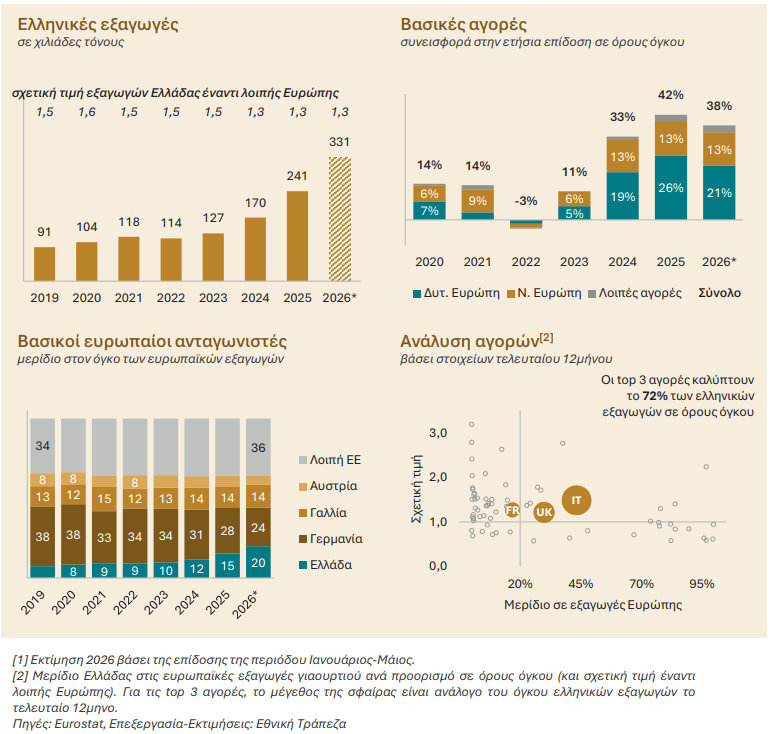
Characteristic of the upward trajectory it has recorded is that between 2019 and 2026 its export volume more than tripled, from 91 thousand to over 300 thousand tonnes. Almost all of the increase came from Western and Southern Europe, which absorbed 97% of the additional volumes and grew at the same time at an average annual rate of about 20%.
The deepening strategy
This growth was 4 times faster than that of total European yogurt exports, which grew by about 5% annually. As a result, Greece’s share of European yogurt exports rose to 20% in 2026, from just 7% in 2019.
Despite the more than fourfold increase in volumes, the average export price of Greek yogurt remains about 30% higher than that of its European competitors.
And as the NBG study notes, Greek yogurt is therefore following a deepening strategy, concentrating resources on
mature markets, building stable trade relationships and increasing scale while maintaining high added value.