ON THIS DAY - The liberation of Kastoria
11 November 2026 · 4 min read
By Thodoris Spiliotis
On this day, 11 November 1912, the Greek army liberated Kastoria, after five centuries of the Ottoman yoke.
Kastoria is a beautiful town in Western Macedonia. The Ottomans captured Kastoria in 1383. At the end of the 19th century, Bulgaria, which wanted to conquer Macedonia and Thrace, sent in the komitadjis, who tried by force to make the Macedonians join their own church, cut themselves off from the Orthodox Church of the Ecumenical Patriarchate, renounce their Greek origin and become part of Bulgaria.
In these difficult hours for the Macedonians, in 1900 Germanos Karavangelis, a capable and courageous cleric, was elected Metropolitan of Kastoria. When he arrived in Kastoria he quickly grasped the situation prevailing in Macedonia and began his struggle.
First he toured all the villages of his province, and through his preaching he gave courage to the Macedonians and urged them to struggle so as not to abandon the Orthodox Church. He also united the Macedonians in a common cause, the struggle for the freedom of Macedonia. For this purpose he formed armed groups, which protected the Macedonians from the violent raids of the komitadjis.
He also sent letters to the Greek government, informing it of the situation prevailing in Macedonia. The struggle of Metropolitan Germanos led many soldiers and politicians of the Greek state to fight for the freedom of Macedonia. Some left their families, went to Macedonia and fought for its freedom. Others organised charitable associations aimed at collecting material goods, which they sent to Macedonia.
In 1907, under pressure from the Ottomans, the Ecumenical Patriarchate removed Metropolitan Germanos from Kastoria and transferred him to the Metropolis of Amaseia in Pontus.
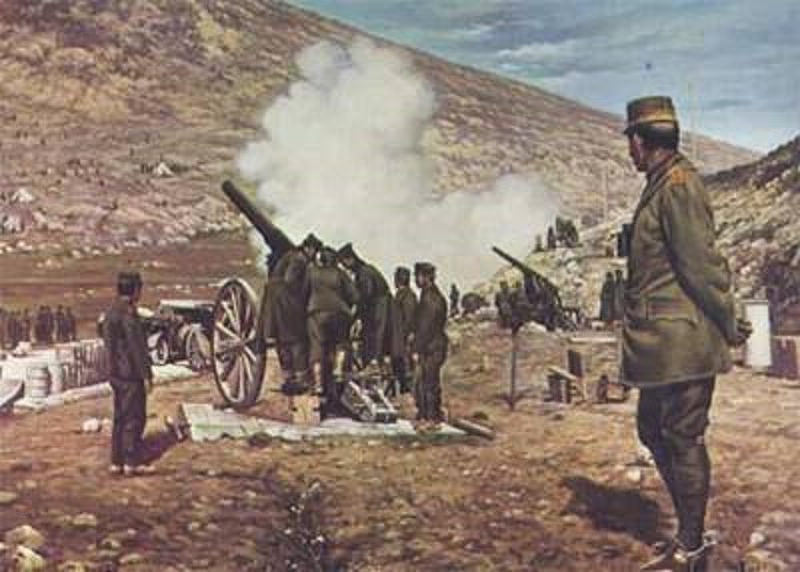
But the seed of the freedom of Macedonia had already been sown. The Greeks continued their struggle for the freedom of Macedonia, and in October 1912 the First Balkan War broke out. The Greek state took part in this war and laid claim to Macedonia. On 9 October 1912 the Greek army routed the Ottomans at Sarantaporo and liberated Kozani.
On 19 October 1912 the volunteer Cretan battalion liberated Neapoli in Kozani and forced the Ottoman army to retreat to Korçë. There the Ottoman army regrouped and advanced eastwards, reaching Siatista in Kozani. There, on 4 November 1912, a fierce clash took place, in which the Cretan battalion wiped out the Ottoman army and liberated Siatista.
The Ottomans finally withdrew from Kastoria, leaving it with a small Ottoman battalion. On 10 November the Army General Staff ordered the 1st Cavalry Regiment to advance on Kastoria.
On 11 November 1912, the Kastorian cavalry second lieutenant Philolaos Picheon entered Kastoria with a few horsemen, where he was welcomed by the Greeks. Then the whole Regiment arrived and they raised the Greek flag in the town, putting an end to Kastoria's Ottoman captivity.
After 527 years, Kastoria became a permanent part of the Greek state. The seed sown by the fighting Metropolitan Germanos Karavangelis, together with the sacrifices of Pavlos Melas and the Macedonian Struggle fighters, led to this glorious result.