8th Sunday of Luke: SAINT CYRIL OF ALEXANDRIA ON THE PARABLE OF THE GOOD SAMARITAN

8TH SUNDAY OF LUKE [:Luke 10:25-37]
SAINT CYRIL OF ALEXANDRIA
ON THE PARABLE OF THE GOOD SAMARITAN
«And behold, a certain lawyer stood up and tested Him, saying, “Teacher, what shall I do to inherit eternal life?”(:Where they were sitting, behold, a certain teacher of the law stood up to test Christ and to prove that Jesus did not know the law, and said to Him: “Teacher, what work of virtue or what sacrifice must I perform in order to inherit the blessed and eternal life?”).He said to him, “What is written in the law? What is your reading of it?” So he answered and said, “You shall love the Lord your God with all your heart, with all your soul, with all your strength, and with all your mind,” and “your neighbour as yourself”(: And the Lord said to him: “What is written in the law? You who study and search the law, what do you read there on this matter? And how do you understand it?” The lawyer then answered Him: “In the law the following is written: ‘’You shall love the Lord your God with all your heart, so that you are wholly given over to Him with all the depths of your inner and spiritual being; and with all your soul, so that you long for Him with all your feeling; and with all your will and strength, so that everything you do is in accordance with His will. And with all your strength and with tireless activity you shall labour to fulfil His will. You shall love Him also with your whole mind, so that you always think of Him. You shall also love your neighbour, your fellow man, as much as and in the way that you love yourself)»[Luke 10:25-27].
By saying «at that time» he means the time during which the Saviour dwelt on earth, He who is present everywhere and does not depart from His Father’s realm. Lawyer is what the evangelist here calls the one versed in the laws, according to the custom of the Jews, that is, one who thinks he knows the law but in reality does not yet know it. This man thought he would ensnare Christ. And among whom, I will tell you. Certain tale-bearers, accustomed to loose talk, went about the whole land of the Jews, even Jerusalem itself, accusing Christ and saying that the commandment given through Moses was useless, while He was bringing new teachings. But there were also some of those who had already believed, who opposed what those men said, accepting everywhere the evangelical and saving preaching.
So the lawyer, wishing, that is, thinking that he would trap Christ into saying something against Moses, that is, against the commandments that Moses had handed down, by saying that His own teaching was superior, approached Him, testing Him and saying: «What shall I do to inherit eternal life?». He approaches Him with hypocrisy and a feigned manner, and pretending to honour Him, he calls Him teacher, so that his deceitful testing would not be noticed behind his fine words. But one of those who know the mystery of the Incarnate dispensation could say to him: «If you knew the law well and the deeper meaning of the teaching hidden in it, you would not be unaware that He whom you attempt to test knows hidden things and can see clearly the hearts of those who approach Him. You call Him teacher, yet you cannot bear to learn. You pretend to honour Him, while waiting to trap Him».
Note, I pray you, once again the malice in the lawyer’s words. For while he could have said: «What shall I do to be saved?», that is, «to please God and to receive the reward from Him?». Yet he leaves those words aside and rather uses the words of the Saviour, bringing ridicule down upon his own head. For since Christ, the Saviour of all, was accustomed to speak often of eternal life to those who came to Him, the boastful lawyer, speaking, as I said, uses His own words.
But if you were truly eager to learn, lawyer, you would have heard from Him the things that lead to eternal life, but since you test Him with evil intent, you will hear nothing else but only what was legislated in ancient times through Moses, which evidently did not have eternal life as their reward, but only the life given here, and deliverance from evils and the recompense of better things. For the prophet Isaiah says: «If you are willing and obedient, you shall eat the good of the land; but if you refuse and rebel, you shall be devoured by the sword; for the mouth of the Lord has spoken(:If, then, you are willing and listen to me and conform to my commandments, you will eat abundantly of the good things of the land. But if you are not willing and do not obey me and turn away from me, the sword of your enemies will devour you.” It is the mouth of the Lord that has proclaimed these things, and they will come to pass as He has said)» [Is. 1:19-20].
«And He said to him, “You have answered rightly; do this and you will live.” But he, wanting to justify himself, said to Jesus, “And who is my neighbour?”(:Then the Lord said to him: “You have given the right answer. Always do what you have said, and you will inherit the kingdom of God and live in it.” But the teacher of the law, wanting to justify himself, since, as it turned out, he had put to Jesus a question to which he knew the answer, said to Jesus: “And whom must I consider my neighbour according to Holy Scripture?”)»[Luke 10:28-29].
However, when the lawyer stated what is written in the law, rebuking his wickedness and exposing his perverse, arrogant mind, Christ, who knows all things, said: «You have answered rightly. Do this and you will live». The lawyer lost his prey; the net of deceit was torn. Let us then say to him the words of Jeremiah: «You have been found and also caught, because you have contended against the Lord(:You have been found by your enemies, now powerless, and you have been overcome by them; and this because you stubbornly resisted the Lord)» [Jer. 27:24].
Having failed in the hunt, he rolled into vainglory. From deceit to pride, the vices, as it were, lending him to one another. For he asked not because he wanted to learn but, as the evangelist says, to justify himself. Note, then, how with egotism and at the same time with haughtiness he shouted shamelessly: «And who is my neighbour?». «Who is he», he says, «that I should love him as myself? I am superior to all, I am a lawyer, I judge everyone and am judged by no one; I sit in judgement and am not judged; I differ from all; all have need of me, I have need of no one; who then is my neighbour, that I should love him as myself?». Is no one, then, like you, lawyer? Do you place yourself beyond all? Lower your brows; remember the author of Proverbs who says: «An evil man does evil with insolence, but those who know themselves are wise(:The unrepentant evil man commits evil boldly and boasts of it. But those who have self-knowledge are wise and humble-minded)» [Prov. 13:10].
Truly the meaning of life lies in this, in loving God and our neighbour, without these being exchanged by us, but extending them beyond Jewish measures, and including that extension in the meaning of the commandments that have been spoken. For loving God with all our heart and soul and strength excludes love of money, of pleasure and of vainglory; it takes us out of the worldly disposition, makes us chosen out of the world, unites us with Christ and, to speak generally, makes us Christians instead of Jews. And love of neighbour, rightly understood, when it is directed not only towards one’s compatriot but towards everyone of the same human race, becomes a follower of the love of God, taking on also the imitation of Christ: loving our neighbour not only as ourselves but even more than ourselves, so as to lay down our life for our friends, which indeed the Lord did.
And the lawyer was indeed praised for his good answer, but he displayed the passion of his arrogance by saying that no one was his neighbour, because no one was his equal in righteousness. For he believed what that Pharisee also believed, who said: «God, I thank You that I am not like other men—extortioners, unjust, adulterers, or even as this tax collector(:I thank You, my God, because I am not like other people, extortioners, unjust, adulterers, or even like this tax collector)»[Luke 18:11], not knowing that this harms righteousness: not doing out of love what one does. So he too is caught being poor in love, certainly in love towards God, but, as is evident, also in love towards his neighbour, since he considers that there is no neighbour for him. And it is clear that, since he does not love the brother whom he has seen, he cannot love God, whom he has not seen.
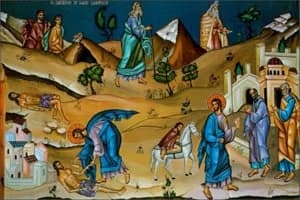
«Then Jesus answered and said: “A certain man went down from Jerusalem to Jericho, and fell among thieves, who stripped him of his clothing, wounded him, and departed, leaving him half dead. Now by chance a certain priest came down that road. And when he saw him, he passed by on the other side. Likewise a Levite, when he arrived at the place, came and looked, and passed by on the other side. But a certain Samaritan, as he journeyed, came where he was. And when he saw him, he had compassion(: Then Jesus, taking this occasion, spoke and said: A certain man was going down from Jerusalem to Jericho and fell into an ambush of robbers. They were not content only to take his money, but also stripped him, wounded him, covered him with blows and went away, leaving him half dead. By chance a certain priest was then going down that road, and although he saw him, he passed by on the opposite side of the road without paying him any attention or giving him any help. Likewise a certain Levite who was passing by that place, although he came near and saw the wounded man, at once moved away and he too passed him by on the opposite side of the road. But a Samaritan who was travelling along that road came to the place where he lay, and when he saw him he had compassion on him and felt for him)»[Luke 10:29-33].
Note how the Saviour shows who the neighbour is, defining him not by race, nor examining his virtue, but connecting him with nature, telling of the one who suffered terribly at the hands of robbers, to whom kindness is due from every human being, because nature itself demands this. And the parable also shows this, that it is the one who is not proud, rather than the haughty one, who finds his neighbour by nature. For the Samaritan is shown to be superior to the priest and the Levite. For they, while the man lay half dead and terribly injured, passed him by, without feeling anything human for him, without pouring out the oil of love, but rather displaying a merciless and hard disposition, whereas the foreigner, who belonged to the Samaritans, fulfilled the law of love. Listen now to the parable:
«So he went to him and bandaged his wounds, pouring on oil and wine; and he set him on his own animal, brought him to an inn, and took care of him. On the next day, when he departed, he took out two denarii, gave them to the innkeeper, and said to him, “Take care of him; and whatever more you spend, when I come again, I will repay you”(: Then he came near him and bound up his wounds with bandages, having first washed them and anointed them with oil and wine. And then he put him on his own animal, took him to an inn and cared for him, thus interrupting his journey. The next day in the morning, leaving the inn where he had spent the night, he took out two denarii, gave them to the innkeeper and said to him: Take care of him so that he gets well. And whatever more you spend, I will pay you when I return to my homeland and pass this way again)»[Luke 10:34-35].
According to another interpretation: Since, according to what is written: «Man, being in honour, did not understand; he was compared to the senseless beasts and became like them(:O wretched man! Although he has received from God the incalculable honour of his rational nature, he did not understand it and did not come to his senses, but was made equal to the irrational and senseless beasts and became like them in his way of life and his instincts)»[Ps. 48:21], and he was overcome by every bestial and licentious desire, since Christ, who knew no sin, became the firstfruits of our race, He first showed in Himself how we may overcome these bestial passions; for He took our infirmities and bore our sicknesses. That is why He said that the one who was healed was placed upon His own beast of burden. For He brought us to Himself, because we are members of His body. And He also took him to an inn; by inn He means the Church, which receives and holds everyone.
For we will no longer hear, according to the narrowness of the shadow of the law and of formal worship: «An Ammonite or Moabite shall not enter the assembly of the Lord; even to the tenth generation none of his descendants shall enter the assembly of the Lord forever (: into the assembly before the Lord no Ammonite or Moabite is permitted to come, even to the tenth generation. For all ages none of them shall enter the assembly of the Lord)»[Deut. 23:4], but «go therefore and make disciples of all the nations, baptizing them in the name of the Father and of the Son and of the Holy Spirit(:Go now, then, and teach the truth to all the nations. And those who believe and become your disciples, baptize them in the name of the Father and of the Son and of the Holy Spirit)» [Matt. 28:19] and «but in every nation whoever fears Him and works righteousness is accepted by Him(:but in every nation, everyone who reveres God and practises righteousness in his life is accepted by Him)» [Acts 10:35].
And having brought him to the inn, he asked that he receive greater care. And indeed, when the Church was formed from the nations made dead by polytheism, Christ Himself, according to what is written, was dwelling and walking within her and bestowing every spiritual gift.
That is why to the keeper of the inn too (he may be regarded as a type of the apostles and of the shepherds and teachers after them), ascending into heaven, He gave two denarii, so that he might care for the sick man with great diligence. And He further said to him: «If you spend more, when I return I will give it to you». By two denarii He means the two Testaments, both the one given through the law of Moses and the prophets and the one given through the Gospels and the apostolic ordinances, both of which were of one God and bore one image of the heavenly and one King, like the denarii, and sealed and imprinted the same character in our hearts through the sacred words, for in them the same Spirit had spoken.
Let Mani perish, and before him Marcion, those most godless men, who ascribe these to different gods; for the two denarii belong to the kingdom of one, and both together and in equal honour were given by Christ to the keeper of the inn, which the shepherds of the most holy churches, receiving them, increased through the labours and sweat of their teaching, and spent them within the Church, and by spending increased them even more(for such is the spiritual silver: while it is spent it does not decrease but increases, which is the word of teaching), and when the Lord returns, on the last day, each one will say: Lord, You gave me two denarii; behold, spending them among my flock, I have gained two more, with which I increased the flock. And He will answer and say: «Well done, good and faithful servant; you were faithful over a few things, I will make you ruler over many things. Enter into the joy of your lord(:Well done, good and faithful servant! You were faithful in a few things, I will set you over many. Enter in to share in the joy of your Lord)»[Matt. 25:16-21].
«“So which of these three do you think was neighbour to him who fell among the thieves?” And he said, “He who showed mercy on him.” Then Jesus said to him, “Go and do likewise”(: So, Jesus asked in conclusion, which of these three seems to you to have done his duty towards his fellow man and proved in practice to be the neighbour and brother of the one who fell into the hands of the robbers? And he said: “The one who had compassion on him and showed him mercy proved to be his ‘neighbour’.” So Jesus said to him: “Go and do the same yourself”)».
That is, show sympathy to every person who suffers, without examining whether he is your relative or your compatriot, and without counting the sacrifices and labours and expenses you will undergo in order to help and assist the one who suffers, even if he is your enemy. So too Christ, whom His enemies reviled as a «Samaritan», became the good and kind Samaritan to humanity, wounded all over and half dead from sins. And in order to heal it of its wounds, He not only endured labours but submitted even to death on the cross)»[Luke 10:36-37]; [interpretive rendering by Panagiotis Trembelas].
Rightly the Lord asked which of the three he considered had become the neighbour of the one who suffered. And he answered: «The one who showed him mercy. For neither the priest nor the Levite became the neighbour of the one who suffered, but the one who showed him mercy». And to this the Lord answered: «Go and do likewise». For the dignity of the priesthood is of no benefit to those who have received it, nor is being called learned in the law to those who think themselves learned in the law, if they do not prove themselves by their very deeds. Behold, then, the crown of love has been woven for the one who loved his neighbour. He was a Samaritan, but not contemptible.
That is why the first among the disciples, namely the blessed Peter, confessed, saying the following: «In truth I perceive that God shows no partiality. But in every nation whoever fears Him and works righteousness is accepted by Him(:Truly, I now understand very well that God shows no partiality. But in every nation, everyone who reveres God and practises righteousness in his life is accepted by Him)» [Acts 10:34-35]; for the Lord, who loves virtue, receives all those who are lovers of good works, embraces them, regards them as His own and makes them worthy of the good things to come.
TO THE GLORY OF THE HOLY TRIUNE GOD,
text editing: Eleni Linardaki, philologist
SOURCES:
- Saint Cyril, Archbishop of Alexandria,Commentary on the Gospel according to Luke, University of the Aegean, research project «The Paths of Faith: Digital Patrology».
(https://greekdownloads3.files.wordpress.com/2014/09/commentarii-in-lucam_.pdf)
- Saint Cyril of AlexandriaComplete Works, Patristic Publications «Gregory Palamas», publishing house «To Vyzantion», Thessaloniki 2005, «Commentary on the Gospel according to Luke, Vol. I», chapter 10th, pp. 437-447.
- P. Trembelas, The New Testament with a Brief Interpretation(rendering in common Modern Greek), publications of the Brotherhood of Theologians «O Sotir», fourth edition, Athens 2014.
- The New Testament, Text and Interpretive Rendering by Ioannis Kolitsaras, publications of the Brotherhood of Theologians «I Zoi», thirty-third edition, Athens 2009.
- The Old Testament according to the Seventy, Text and Brief Rendering of the Meaning by Ioannis Kolitsaras, publications of the Brotherhood of Theologians «I Zoi», fourth edition, Athens 2005.
- http://www.greek-language.gr/digitalResources/ancient_greek/tools/liddell-scott/index.html
- http://users.sch.gr/aiasgr/Kainh_Diathikh/Biblia/Kainh_Diathikh.htm
- http://users.sch.gr/aiasgr/Palaia_Diathikh/Biblia/Palaia_Diathikh.htm